
Dakota County
Hoarding and biohazard cleanup in South Saint Paul, Minnesota.
Discreet cleanup for South Saint Paul’s older homes — hoarding, gross filth, odor removal, estate clearing, and after-death care. Unmarked vehicles, no judgment. Call us.
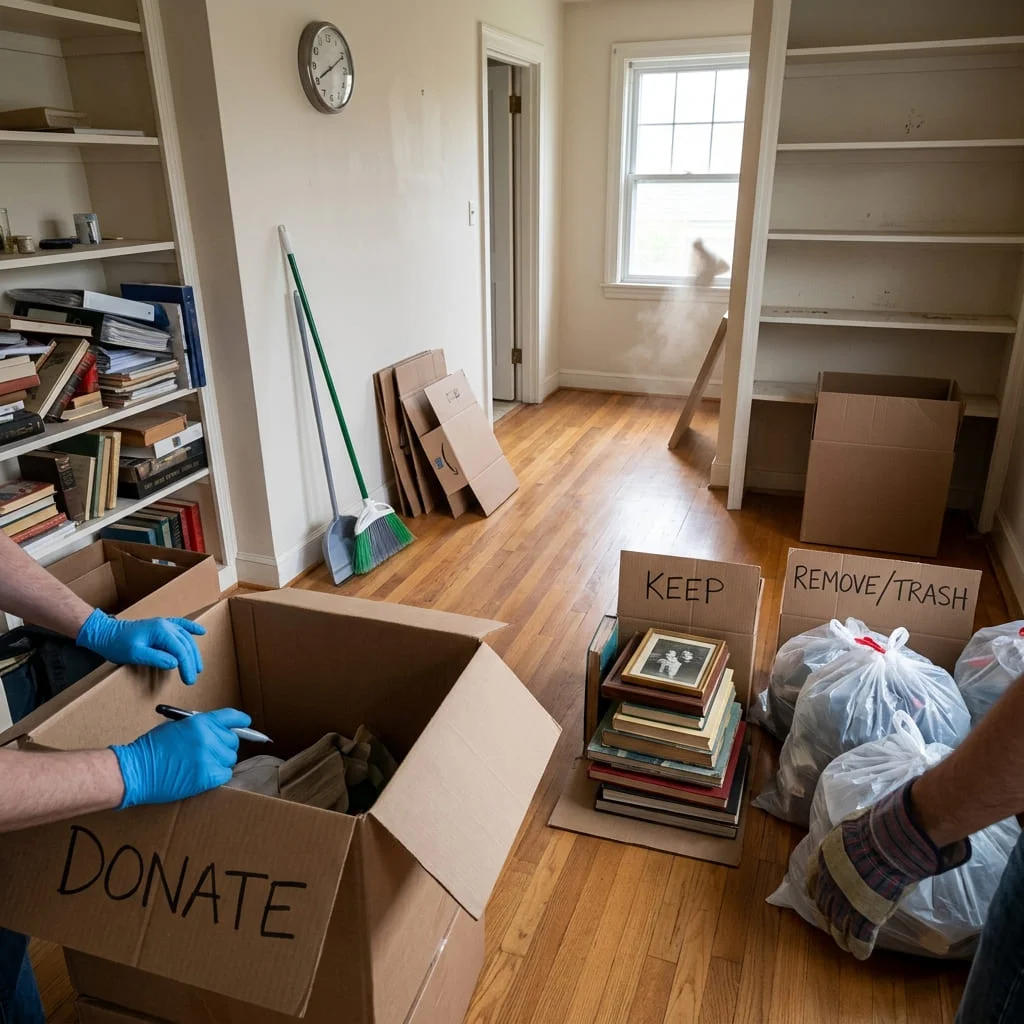
South Saint Paul is a dense grid of small, well-built houses on small lots, most of them put up between the nineteen-tens and the nineteen-fifties for families working at the stockyards and the packing plants. Alleys, detached garages, story-and-a-half roofs, and a great many households that have been in the same house for generations. Biohazard Cleanup MN covers South Saint Paul as part of our regular service area, with hoarding cleanup first and gross filth remediation, odor removal, estate clearing, and after-death care alongside it.
The housing stock changes how these situations should be judged. In a small house, the point at which life becomes genuinely difficult arrives at a far lower volume than it would in a large one — which means families here routinely underestimate what they are looking at, because it does not resemble what they have seen elsewhere.
Services in South Saint Paul
Hoarding cleanup leads — the rest follows as needed.
Hoarding and squalor account for most South Saint Paul calls. Where a death, an active biohazard, or a full estate clearance is part of it, the same visit covers all of it.
- Hoarding Cleanup Flagship Compassionate, judgment-free clearing of hoarded homes — one room at a time. View details
- Unattended Death Cleanup Careful, discreet cleanup after a death that went undiscovered. View details
- Crime Scene Cleanup Thorough biohazard cleanup and restoration after a crime. View details
- Blood & Bodily Fluid Cleanup Proper decontamination of blood and bodily-fluid spills. View details
- Suicide Cleanup Gentle, private cleanup so families never have to face the scene. View details
- Gross Filth & Squalor Cleaning Deep cleaning and sanitizing of severely neglected living spaces. View details
- Estate Cleanouts Full property clearing when a home also needs biohazard care. View details
What a small house runs out of first
A small house runs out of things in a specific order, and that order
is a far better guide to urgency than any photograph. Severity in this
work is not really a measure of how much somebody owns. It is a
measure of what their home can no longer do — and a compact
nineteen-twenties house reaches that point on a fraction of the volume
a modern one would need.
Which is genuinely good news in one respect: the first items on this
list are also the quickest to put right. A great deal of the real risk
in a small house can be removed in the first day, long before the job
as a whole is finished.
| What goes | Why it matters here |
|---|---|
| Floor space, first and fastest | A nine-hundred-square-foot house runs out of floor before anything else, and it does so at a volume that would barely register in a large home. This is why comparing your parents’ house to a photograph online is so misleading. The same quantity of belongings that leaves a four-bedroom two-storey looking untidy leaves a small South Saint Paul bungalow genuinely difficult to move through — and severity, for every practical purpose, is about what the house can still do rather than what was acquired. |
| The second way out | The second exit is the first safety item to disappear, and it disappears quietly. A back door blocked by stacked items, a stair to a half-storey that can only be climbed sideways, or a basement window well that no longer opens leaves one usable route out of the building. In an older house with a single interior stair and a wood-framed story-and-a-half upstairs, that is the single most important thing to restore — and it is usually restorable in a day. |
| Clearance around the furnace and water heater | Combustion appliances need air and space around them, and a small basement does not offer much of either to begin with. Boxes and textiles stacked against a furnace or a water heater are both a fire concern and a combustion concern, and in a tight old basement this is the condition that most often turns a cleanup into something urgent. Where stored items are in contact with the appliances, that area gets cleared first regardless of what else is planned. |
| Access to the electrical panel | Panel access is a requirement rather than a courtesy, and it is the thing an inspector looks for immediately. A panel that cannot be reached and opened freely is a problem for anyone who has to work on the house, and in a small basement it is one of the first spaces to get built in with shelving or stacked storage. Clearing a working space in front of it is quick, cheap, and one of the more useful hours of a whole job. |
| The room the house depends on | Finally the house loses the one room it cannot function without — usually the kitchen or the single bathroom. Where there is only one bathroom, its loss is what turns a difficult situation into a health situation, and it is frequently the point at which somebody outside the household finally hears about it. That room is restored first, before anything cosmetic and before any of the rooms that merely look bad. |
None of this is a code inspection and none of it is offered as one. Where a property needs an electrician, a heating contractor, or the city, that is what it needs — and saying so is more useful than a cleanup company pretending the distinction does not exist.
Call (612) 493-2982Why the safety items are cleared before the visible ones
The safety items get cleared before the visible ones, even though the
visible ones are what everybody is embarrassed about. It is a
deliberate reversal. The rooms a family most wants dealt with are
usually the ones a visitor would see, while the conditions that could
actually hurt somebody are in the basement, the back hall, and the
blocked doorway nobody mentions.
Doing it this way also makes the rest of the job easier to accept. A
household that has watched the exits, the furnace surround, and the
bathroom restored in the first day has seen that nothing was thrown
out behind their back and that the work moves at a pace they set. That
matters more than speed. Our
Mendota page covers what survives
in an old house material by material, and
how long a hoarding cleanup takes
gives realistic timelines by size.
What a South Saint Paul cleanup involves
A South Saint Paul cleanup involves sorting first, then cleaning, then
verification, in that order and at whatever pace the household can
manage. Documents, photographs, keepsakes, medications, cash,
jewellery, and anything of value are set aside for the family or the
executor rather than cleared into a load — in a house held by one
family for decades that step is most of the trust in the job.
Then the surfaces underneath are cleaned and decontaminated, pests are
addressed where present, affected materials are removed rather than
sealed over, and odor is neutralised at its source. Many cleanups of
this kind are covered in whole or in part by homeowner’s insurance
depending on the cause and the policy. See
hoarding cleanup for the
method in full,
gross filth and squalor cleaning
where a home has gone years without upkeep,
estate cleanouts when a
family home has to be cleared, and
unattended death cleanup
where someone has passed away at home. To talk it through,
call (612) 493-2982.
Coverage & response
Serving South Saint Paul, West Saint Paul, and the north end of Dakota County.
Response time
Call for availability. If the situation involves a death, an active biohazard, or a blocked exit, say so at the start of the call.
Who calls us here
Adult children arranging help for a parent, long-time owners calling for themselves, executors settling a family home, landlords and property managers, home care aides and case workers, and neighbours who are not sure who else to ring.
Nearby communities
We cover all of Dakota County and the six other metro counties. The nearest communities with their own pages are linked here.
Rosemount, MNMendota, MNInver Grove Heights, MN All Dakota County & metro areas
Frequently asked
South Saint Paul questions, answered honestly.
How bad is this, really? It does not look like the pictures online.
It is a fair question and the pictures online are a poor yardstick, because they are almost all taken in large houses. Severity is better judged by what the house can still do: can you walk to both exits, is the bathroom usable, is the kitchen usable, can you reach the furnace and the panel, and is there a clear path to a bed. A small South Saint Paul house can fail several of those at a volume that would look mild in a big suburban home. Our guide on the five levels of hoarding explains the scale professionals use, and there is no charge for describing it over the phone — call (612) 493-2982.
Does a smaller house mean a cheaper cleanup?
Often yes, and not always by as much as people expect. Volume is the main driver and a small house holds less of it, so a great many South Saint Paul jobs are genuinely at the lower end. What pushes back the other way is access: narrow stairs, small doorways, no driveway, an alley rather than a kerb, and a carry distance to wherever a container can legally sit. Those add hours that square footage does not predict, which is why an honest estimate comes from a walkthrough rather than from a number of rooms. Our guide on hoarding cleanup cost in Minnesota sets out what actually moves the price.
My father has lived in this house since the sixties and will not discuss it.
That is the most common version of this call in a city with this much long tenure, and the length of tenure is part of why. Sixty years in one house means every object has a history attached, and it means the person is being asked to undo a lifetime rather than tidy a room. What tends to work is small and specific: one room rather than the house, a question rather than an announcement, and the safety items first because they are the easiest to agree on. Nothing is taken without being asked about. Our guide on how to help a family member who hoards is written for this conversation.
Can this be done quietly on a street where the houses are close together?
Yes, and it is planned rather than promised. Vehicles are unmarked and plain, nobody wears clothing with a company name on it, and materials are bagged inside the house rather than carried out loose. On a small lot the honest constraint is where a container can go — often the alley or the street rather than a driveway — so the plan usually favours several smaller loads over one large container sitting outside for a week. Tell us what matters to you on the first call and the work is arranged around it. Reach us on (612) 493-2982.
A small house gets difficult sooner — that is not a failure.
Describe the property and we will tell you what is involved, what it is likely to cost, and how soon we can be there.